Softbox vs Umbrella: Which Portrait Light Fits?
- Published
- Reading time
- 8 min read
- Prepared by
- LiteGallery editorial team
A softbox suits portraits that need controlled, directional light; an umbrella is the better fit when you want a quick, broad spread. Choose by the look and control your setup needs.
Both modifiers soften light, but they shape and contain it differently. That affects how much light reaches the background, how precisely you can place highlights and shadows, and how easily the setup adapts to a small room or a changing subject.
This guide compares softbox vs umbrella for portrait lighting, so you can match the modifier to your space, workflow and preferred look.
| Criterion | Softbox | Umbrella |
|---|---|---|
| Light spread | More directional | Broad spread |
| Spill in a small room | Usually easier to contain | More likely to bounce around the room |
| Setup | Usually more assembly | Quick and user-friendly |
| Portability and cost | Usually more expensive | Generally lightweight and budget-friendly |
How does a softbox differ from an umbrella?
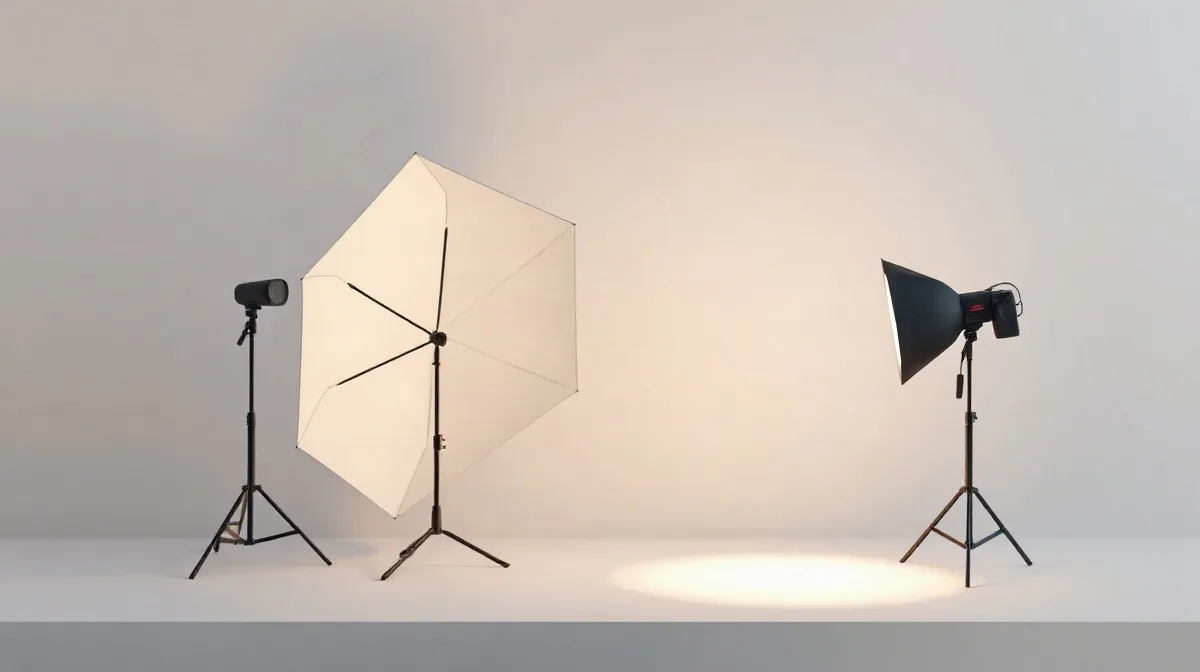
A softbox encloses the light and sends it through a diffusion face, while an umbrella spreads light more broadly and lets more of it spill around the room. Both can soften light from a flash or continuous source; neither is automatically the better portrait modifier.
- Softbox: Its enclosure helps contain spill, making it useful when you want to keep light off nearby walls or other parts of the scene.
- Umbrella: Its broad spread makes it a quick option for general portrait illumination, but more light reaches the surrounding room.
Control or coverage?
The practical difference is control versus coverage: choose a softbox when limiting spill matters, or an umbrella when you want broad illumination with a quick setup. That distinction is especially useful in a small room, where umbrella light can bounce around more.
The result also depends on the modifier’s size and how far the light is from the subject. A larger modifier placed closer can produce softer-looking light, whether it is a softbox or an umbrella, so either can work for portraits.
Which modifier works better in a small room?
A softbox usually works better than an umbrella in a small room because it directs more of its light toward the portrait and lets less spill bounce around the space. That containment can help keep a nearby wall or background from picking up unwanted illumination, making the subject easier to separate from the surroundings.
Choose between the two by looking at the actual shooting space and the coverage you need:
- Softbox: A practical choice when the subject is close to a wall or background; its more controlled spread can reduce stray light on those surfaces.
- Umbrella: Its broad spread can suit a larger, more open room, or a portrait where wide coverage matters more than limiting spill.
In a cramped setup, a nearby wall makes light bouncing beyond the subject more noticeable, so the softbox’s containment is useful. In an open room, an umbrella’s broader light has more space to travel; choose it when that coverage serves the portrait rather than assuming one modifier is best for every room.
How does distance change the portrait light?
A repeatable close-range test
Moving a softbox or umbrella closer makes it appear larger from the model’s position, which changes the light’s softness and spread. In one comparison, the light was placed 46, 54, 62 and 70cm from the model’s face; these are useful test points, not universal prescriptions.
At each distance, keep the pose and exposure the same, then compare the shadow edges, facial contrast and light spilling onto the background. Changing the placement can alter all three, so look for differences in the photograph rather than assuming that one distance will suit every portrait.
Compare one modifier at a time
For a fair umbrella-versus-softbox test, keep the camera position and modifier placement consistent as you switch between them. An umbrella can spread light more broadly, while a softbox can help limit bounce in a small room; changing distance, camera position and modifier together makes it harder to tell what caused the result.
- Placement: Test both modifiers at 46, 54, 62 and 70cm from the model’s face.
- Comparison: Hold pose, exposure and camera position steady; assess shadow edges, facial contrast and background spill.
Which modifier is faster to set up and carry?
An umbrella is generally faster to set up and position than a softbox, making it the simpler choice for quick portrait sessions. Its straightforward opening mechanism and broad light spread suit photographers who need to get a setup working without much assembly.
Umbrellas are commonly lightweight and budget-friendly, a practical combination when portability matters. Softboxes usually require more assembly and may cost more, but their more controlled light can reduce spill and the need to flag or redirect light in a cramped room.
Check the packed kit before buying
- Umbrella: Check its folded length and how it attaches to the light stand or flash; designs differ, so “umbrella” alone does not tell you how quickly it will pack or mount.
- Softbox: Compare its packed size and assembly method with the space and setup time you have. A softbox’s tighter control may be useful in a small room, but its construction affects how much setup it takes.
What camera limits matter when using flash?
Camera shutter-sync limits matter because they set the fastest shutter speed you can use with a flash without changing how the exposure is made. Most focal-plane shutters used in booth builds, including the Canon R10, Canon R50, Nikon Z5 and Sony ZV-E10, max out between 1/160s and 1/200s.
Check your camera’s flash-sync limit before planning a portrait setup around a fast shutter speed. If you exceed it, the flash may not illuminate the whole frame evenly; changing from a softbox to an umbrella does not remove that camera constraint.
Keep the comparison consistent
A softbox and an umbrella change the spread and quality of the light, not the shutter-sync limit. To compare their portrait results fairly, keep the camera and flash settings fixed while swapping the modifiers.
When can neither modifier solve the problem?
Neither a softbox nor an umbrella is the right choice when the room, setup priorities or test method make its trade-offs unacceptable. In a tight room, an umbrella’s broad spread can bounce off nearby walls and lift unwanted fill; choose a softbox when limiting spill matters more than speed or coverage.
- Choose a softbox when controlling light on the subject and reducing room bounce are the priority.
- Choose an umbrella when quick setup, low cost or broad coverage matters more than directional control; a softbox is not automatically better for those needs.
Neither modifier guarantees soft light by its shape alone. The apparent softness depends on the source’s size as seen from the subject, its distance, and its placement, so a small softbox set far away can produce a different result from a larger source placed close.
Make a fair comparison
A softbox-versus-umbrella test only isolates the modifier if exposure and light position stay consistent between frames. Keep the light in the same place and match exposure; otherwise, a change in brightness or shadow can come from moving the light or changing exposure, not from switching modifiers.
When does color accuracy matter more than modifier shape?
Color accuracy matters more than softbox or umbrella shape when a portrait must reproduce skin tones or brand colors faithfully. For skin-tone color accuracy across brand palettes, choose a light with a CRI of 90+; for color-critical work, the stated threshold is 95+.
CRI describes how a light source renders color, while a modifier shapes the light’s spread and direction. Those are separate buying considerations: a softbox can offer more directional control, while an umbrella can spread light broadly, but neither shape tells you the light’s CRI.
- Skin tones: Check for a stated CRI of 90+ when accurate skin color across brand palettes matters.
- Color-critical portraits: Use 95+ as the stated CRI threshold.
- Modifier choice: After checking CRI, choose a softbox or umbrella for the light pattern you prefer.
If accurate color is central to the portrait, check the light source’s stated CRI before deciding between modifiers. That keeps color rendering and light pattern distinct: first confirm the source meets the relevant threshold, then choose the softbox or umbrella for how you want the light to fall.
Frequently asked questions
Is a softbox or umbrella better for portrait photography?
Which modifier is better for a small room?
How far should a modifier be from a portrait subject?
What CRI should I look for in a portrait light?
What this piece draws on
- thelenslounge.com — “Photography umbrella vs softbox for portrait lighting”
- MoLight — “Softbox vs Umbrella: Which is Better?”
- adorama.com — “Softbox vs Umbrella: Which One Should You Use? – 42West”
- theclickcommunity.com — “Studio lighting: Softbox vs umbrella vs beauty dish”
- theslantedlens.com — “Softbox vs Umbrella, Don’t Make This Rookie Mistake! – The Slanted Lens”