Leading Lines vs Centered Composition

- Published
- Reading time
- 10 min read
- Prepared by
- LiteGallery editorial team
Updated: October 21, 2026
Leading lines guide the viewer’s eye through a frame, while centered composition places the main subject on the central axis. Neither is universally better: leading lines create direction and depth; centering emphasizes symmetry, balance, or the subject’s presence.
The choice depends on what you want the photograph to make the viewer notice and feel. This guide compares leading lines vs centered composition, explains how each shapes attention, and shows when combining them can make a frame more effective.
| Scene or criterion | Leading lines | Centered composition |
|---|---|---|
| Path toward a distant subject | Use the path as a visual route | Use if the scene also has strong symmetry |
| Bridge framed by balanced trees | Use a path to direct attention to the bridge | Center the bridge within the natural frame |
| Several lines point in different directions | Reposition to favor one route | Consider centering if the surroundings balance |
| Foreground line dominates a small subject | Change position or reduce foreground emphasis | Try a balanced frame without a strong foreground route |
What do leading lines do in a frame?
Leading lines in photography are visible edges or features that guide the eye toward a focal point, such as a road, path, riverbank, fence or row of trees. They give the viewer a route through the frame: a path entering from a lower corner, for example, can draw attention inward, while a bridge at the end of it provides a clear destination.
Leading lines do not have to be straight or point directly at one object. A bend in a river or a curved trail can carry the eye through several parts of a scene before it reaches the subject. Their value lies in how they organise attention, not in making a rigid arrow across the picture.
When lines help—and when they distract
Several lines can strengthen a composition when they converge on the same subject, such as a bridge approached by a path and bordered by a fence. But if those lines pull in different directions, they can compete with the focal point; choose a shooting position that makes their direction support it. Unlike a centered composition, which can place a subject such as a bridge in the middle of the frame, leading lines create a visual route toward that subject.
This page compares the two approaches. For the full technique — finding lines, working with perspective and a step-by-step method — read our complete guide to leading lines photography.
What is centered composition in photography?
Centered (or central) composition places the main subject in the middle of the frame, on or very near both the vertical and horizontal centre lines. It deliberately ignores the rule of thirds: instead of creating tension by pushing the subject off-centre, it creates stability, so the frame feels calm, formal and direct.
It is most convincing when the scene itself is symmetrical or when the subject should confront the viewer. Typical cases are reflections in still water, doorways, corridors and tunnels, bridges and façades shot square-on, single objects against a clean background, and portraits in which the person looks straight into the lens.
How to shoot a centered, symmetrical composition
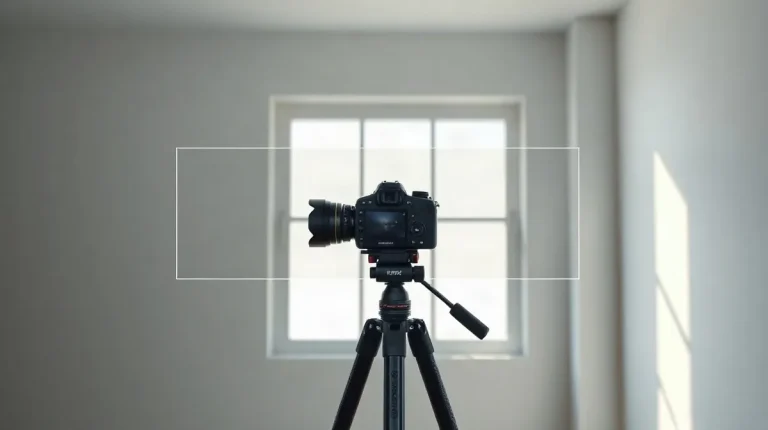
- Turn on the grid and the level. A 3×3 grid shows the centre square; an electronic level or a phone’s level guide stops the horizon tilting, which would break the symmetry immediately.
- Stand on the axis of symmetry. For a corridor, bridge or façade, move until the vanishing point or the central feature sits exactly in the middle. Keep the camera parallel to the main plane; shooting from slightly off to one side makes one half larger than the other.
- Commit fully — avoid “almost centred”. A subject placed a little off the middle looks like a mistake rather than a choice. Either centre it precisely or move it clearly towards a third.
- Check both edges. Compare the space between the subject and the left and right edges, and what sits in each half. A bright car or sign on one side alone will pull the eye and unbalance the frame.
- Use reflections on purpose. With a reflection in water or glass, placing the horizon on the horizontal centre line makes the real scene and its mirror image equal halves.
- Consider a square crop. A 1:1 format has the same distance to every edge, which suits centred subjects and makes the symmetry feel intentional.
- Break the symmetry once, if at all. A single off-axis element — a person walking, one lit window — gives a symmetrical frame a point of interest. More than one usually reads as clutter.
Centered composition vs the rule of thirds
The rule of thirds suits scenes with movement or a strong relationship between subject and surroundings, because the empty side gives the subject room to look or move into. Centered composition suits scenes where balance and the subject’s presence matter more than movement. A quick test in the field is to shoot both: if the off-centre version feels like it is waiting for something to fill the empty side, the centred frame is probably the stronger one.
How do leading lines differ from centered composition?
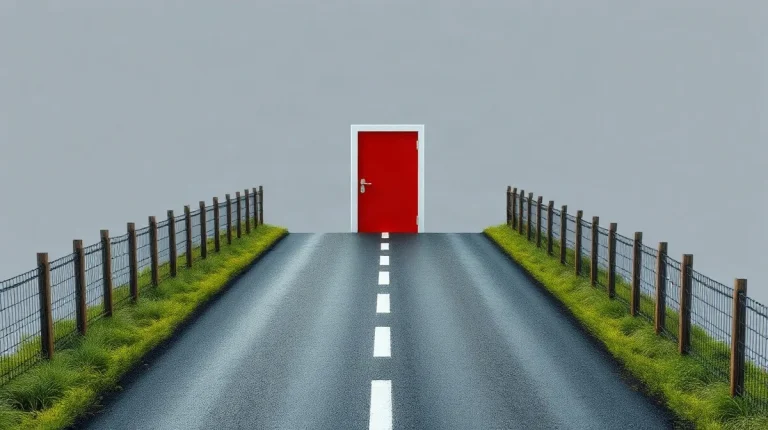
Leading lines create a directional route through the frame, while centered composition places the subject on the central axis and relies more on balance or symmetry. A road narrowing toward a distant building is a leading-line arrangement: its converging edges draw the eye into the scene, and the change in distance is part of the image. By contrast, a stone bridge framed by autumn trees can suit a centered composition when the bridge and its surroundings feel visually balanced.
- Leading lines: The road’s narrowing edges guide attention toward the distant building and create a sense of depth.
- Centered composition: The stone bridge sits on the central axis, with the autumn trees framing it in a balanced arrangement.
Combining the approaches
A bridge can be centered while a path or its converging edges lead the viewer’s gaze toward it. The central placement supplies balance; the path supplies direction. This combination works when the bridge remains the focal point and the lines in the foreground clearly guide attention to it.
How can a photographer make lines lead to the subject?
Start with the frame edges
To make lines lead to a subject, start them at a frame edge—often a lower corner—and place the subject where the lines end or along their route. Check whether a path edge enters from a corner and guides the eye inward; if it points past the subject, it may pull attention elsewhere.
- Path from a lower corner: use its inward direction to draw the viewer into the scene.
- Line that misses the subject: reframe so the intended subject lies at the endpoint or along the line.
Use perspective deliberately
Before changing equipment, move a few steps forward, backward or sideways. A small shift can bring a path edge into a corner or align it with the subject, changing where the line directs attention. A wide-angle lens can include more of an expansive scene, making foreground lines prominent as they recede toward the subject or disappear into the distance.
When is centered symmetry the clearer choice?
Choose centered symmetry when a bridge, doorway or other subject sits within surroundings that are balanced around it. The subject and its setting then read as one orderly arrangement, rather than as a destination reached by a strong visual route.
Rows of trees can frame a centered bridge, adding a natural border while keeping the bridge as the clear focal point. Centering is also useful when the scene has no strong path toward the subject: it establishes order without introducing a directional line that the setting does not provide.
Compare the subject’s role
- Centered frame: Place the bridge in the middle when the rows of trees balance its surroundings and the bridge should feel like the scene’s anchor.
- Corner-entry path: Keep the same bridge, but compose a version where a visible line enters from a corner and leads toward it. Choose this frame when the route into the scene matters more than the bridge’s central position.
Comparing these two frames of the same bridge makes the choice concrete: centered symmetry stresses its relationship to balanced surroundings, while a corner-entry line emphasizes movement toward it. Use the version that makes the bridge’s role clearest.
When do leading lines fail or distract?
Leading lines fail when a road, fence or riverbank pulls attention away from the subject, competing lines split the viewer’s focus, or strong foreground geometry overwhelms what lies farther away. Centered composition can also feel forced when the subject and its surroundings do not balance around the middle axis.
Check the line’s destination
A road that runs out through the frame’s edge can lead the eye away rather than toward a distant subject; a fence or riverbank can do the same if its direction points beyond the picture. When several lines compete, change your viewpoint or simplify the frame to give the most useful line a clear path to one focal point.
- Road: Check whether its visible direction ends at the subject or exits the frame first.
- Fence: Look for rails or posts that pull attention toward a different edge.
- Riverbank: Keep the subject in the direction the bank leads, rather than where the line disappears.
Watch foreground dominance
A wide-angle view can make a nearby path edge look disproportionately large beside a small, distant subject, so the leading line may become the photograph’s main event. Centered symmetry has its own test: compare the subject and its frame on both sides of the middle axis. If uneven surroundings make that balance feel artificial, use an off-centre placement instead.
How should you choose between the two compositions in the field?
Choose leading lines when a road, trail or riverbank creates a clear route into the frame; choose centered composition when symmetry is the scene’s stronger organizing feature. Keep the same focal subject in both versions so you can compare how the framing directs attention, rather than comparing different scenes.
Make two frames, then check what leads the eye
- Road, trail or riverbank: First place the line at an edge of the frame and let it point toward your subject. Check whether it draws the eye into the scene and gives the subject a clear visual approach.
- Bridge framed by trees: If the trees and surroundings appear symmetrical, make a centered version with the bridge in the middle. Then make another frame that gives more emphasis to a path, and compare which structure feels more prominent.
- Both compositions: Keep the focal subject unchanged. Review the frame edges to see where the line enters, then follow it to its endpoint; a line that arrives clearly at the subject favors leading lines, while balanced surroundings favor a centered composition.
Compare the two frames by the attention path each creates: does the eye travel along the road or path to the subject, or does the centered bridge and its framing trees hold the scene together? Choose the version that makes that relationship easiest to read.
Frequently asked questions
Do leading lines have to be straight?
Where should a leading line start?
Is a wide-angle lens necessary for leading lines?
Can I use leading lines with a centered subject?
What is central composition?
Is centering the subject a mistake if it breaks the rule of thirds?
What this piece draws on
- digital-photography-school.com — “Leading Lines in Photography: The Essential Guide”
- PetaPixel — “28 Composition Techniques That Will Improve Your Photos”
- iphonephotographyschool.com — “10 Great Ways To Use Leading Lines In Your iPhone Photos”
- constancemierphotography.com — “Constance Mier Everglades photography – learn to use dynamic leading lines in nature photographs”
- pmc.ncbi.nlm.nih.gov — “Impact of Leading Line Composition on Visual Cognition: An Eye-Tracking Study”