Layflat vs Standard Photobooks: Which Works Better?
- Published
- Reading time
- 6 min read
- Prepared by
- LiteGallery editorial team
Layflat photobooks work better for panoramic images and spreads that should flow across the center; standard photobooks suit most everyday layouts. The right choice depends on your photos and how you want them to appear on the page.
A layflat binding opens with little curvature at the spine, so a photograph can cross two pages with less visual interruption. Standard books have a more noticeable center fold, but their familiar page format works well when images and text sit within each page.
In this comparison, we look at how each binding affects image layout, handling, and cost, so you can choose a photobook that fits the way you plan to use it.
| Criterion | Layflat binding | Standard binding |
|---|---|---|
| Across the center seam | Opens flat; better for a continuous panorama | Pages curve into the spine; center detail can be obscured |
| Page construction | Rigid panels; some makers use a folded sheet per spread | Conventional pages gathered at the spine |
| Best image layout | Panoramas, wide group photos and continuous spreads | Separate images and page-by-page layouts |
| Cost consideration | Compare provider pricing for the chosen size and specification | Photobook Press positions it as more accessible for a series |
- more than 100 countries Countries where Double100 says it delivers solutions
- 20+ global agents Global agents Double100 says support its delivery
How does each binding handle a panorama across the center?
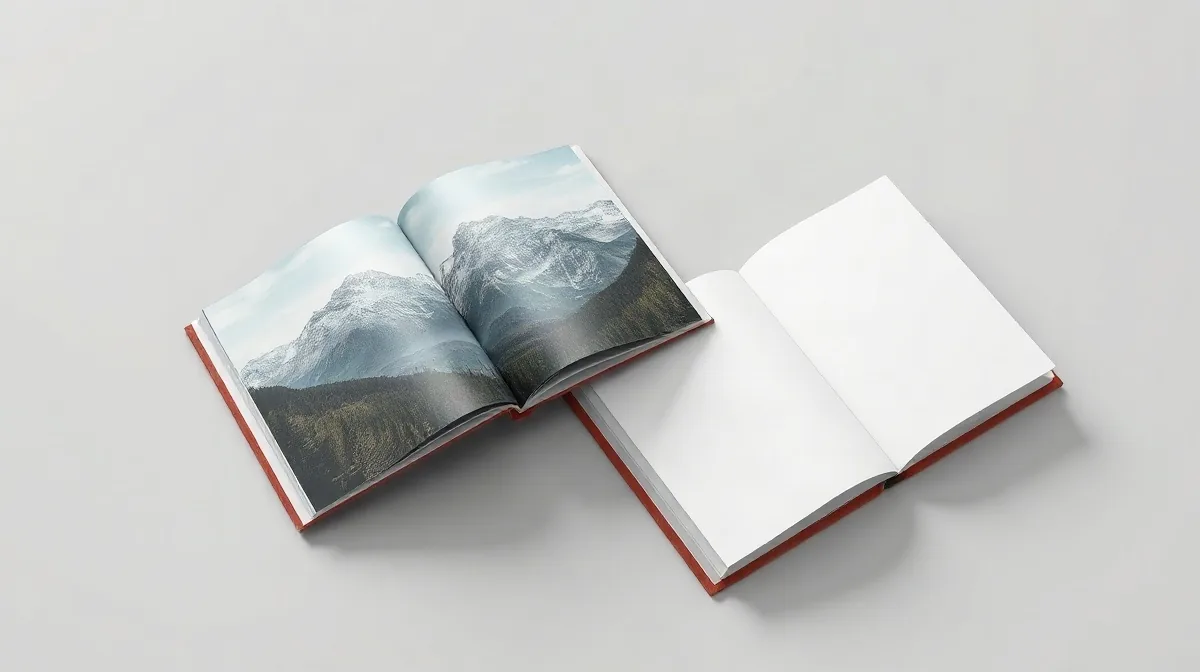
Layflat binding handles a panorama better than standard binding because the spread opens flat, leaving less of the image hidden at the center. A skyline, mountain range or long wedding-party lineup can continue across both pages as one wide composition.
- Layflat: The pages lie flat across the spread, so more of a wide image remains visible.
- Standard: The pages curve inward where they meet at the spine, making details near the fold harder to see.
Even in a layflat photobook, keep faces, text and other essential details away from the seam. The binding reduces the obstruction; it does not make the center a reliable place for critical details.
What is physically different about layflat pages?
Layflat pages use rigid panels that open flat instead of bending into a conventional spine. That construction keeps the center of a spread open, so an image can run across both pages without the inward curve of a standard photobook.
PikPerfect describes its layflat spreads as a sheet folded at the center and glued to the next spread. The result behaves as a connected spread rather than as separate pages gathered at a binding: the panels stay flat when the book is open. In a standard photobook, pages meet at the spine and curve inward, which can obscure part of an image crossing the center.
When is standard binding the more practical choice?
Standard binding is the more practical choice when each photograph can stand on its own page and a lower-cost format matters more than a spread that opens completely flat.
Photobook Press describes standard binding as a more accessible-price option for a series of books. That can suit a collection organised by school year, with portraits, small details or short captions on separate pages.
- Individual page compositions: Keep each photograph on one page rather than placing a key part of it across the spine.
- A deliberate page turn: Use portraits, details and captions as a sequence; they do not need to form one uninterrupted panorama.
- A series on a budget: Choose standard binding when its more accessible price matters more than a completely flat spread.
Which format is better for page durability and handling?
For a heavier, more substantial-feeling spread, choose a layflat photobook; for frequent page turning, standard pages are the more conventional choice.
- Layflat: Rigid panels open into a flat spread. Artifact Uprising describes its layflat books as having thick, durable pages designed for longevity, but the exact materials can vary by product.
- Standard: Pages bend at the spine and feel more like a conventional book, making them a familiar option for repeated browsing.
Durability depends on the specific book’s paper and construction, not just its binding label. Before ordering, check the maker’s details for the paper type and how the pages are built. “Layflat” alone does not promise a particular paper, finish or lifespan.
How much does layflat binding cost compared with standard?
Standard photobooks can be the more accessible-price option, while layflat binding generally costs more because it uses rigid panels.
There is no fixed price gap: the total depends on the book’s size, page count, paper and maker. Compare matching options on each provider’s current product pages:
- Standard binding: check the price for the dimensions, image count and paper you need.
- Layflat binding: compare the same specifications, including the paper choice.
- Multi-book projects: compare the total cost of the full series, not just the price of one copy.
A lower price for one book may not make standard binding the better value for a complete project. Check the whole order before choosing.
When does layflat not solve the design problem?
Layflat binding does not fix a panorama that is badly cropped or places faces, lettering or other key details on the fold. It opens the spread flat, but the image still needs careful composition.
A panoramic image can instead fit on one page in either a layflat or standard photobook. That avoids the center seam, though shrinking the image can make fine detail less prominent.
- Use layflat when one image needs to run across both pages and important details can stay clear of the fold.
- Use standard binding when the spread has separate images or text that do not cross the center seam.
Before ordering, preview the center of every spread. Move faces, lettering and focal details away from the binding, and check that a full-spread panorama is not cropped awkwardly.
What should you check before ordering a layflat book?
Before ordering a layflat book, confirm how the provider defines its binding, whether every spread opens flat, and which paper, finish, service and warranty terms apply to the specific product.
- Binding: Check that the pages open flat across every spread, not only selected layouts. This matters when a panorama crosses the centre fold.
- Paper and finish: Artifact Uprising lists Superfine/Matte and Lustre for some products, with the Everyday Photo Book as an exception. Confirm the options for the book you want.
- Warranty: Double100 says its products come with a 3-year warranty. Verify that the specific book you are considering is covered and check the terms directly.
- Delivery and service: Double100 says it delivers solutions to more than 100 countries, supported by 20+ global agents. Confirm service availability and warranty terms for your order directly with the provider.
Sources
- Crafted Memories — “What Is a Layflat Photo Album?”
- prestophoto.com — “Layflat Photo Books: An explanation – PrestoPhoto”
- saal-digital.com — “Layflat Photo Book Binding vs Other Binding Types – Saal Digital”
- Artifact Uprising — “Comparing Our Layflat Albums”
- PikPerfect — “Stunning Layflat Photo Books & Albums”